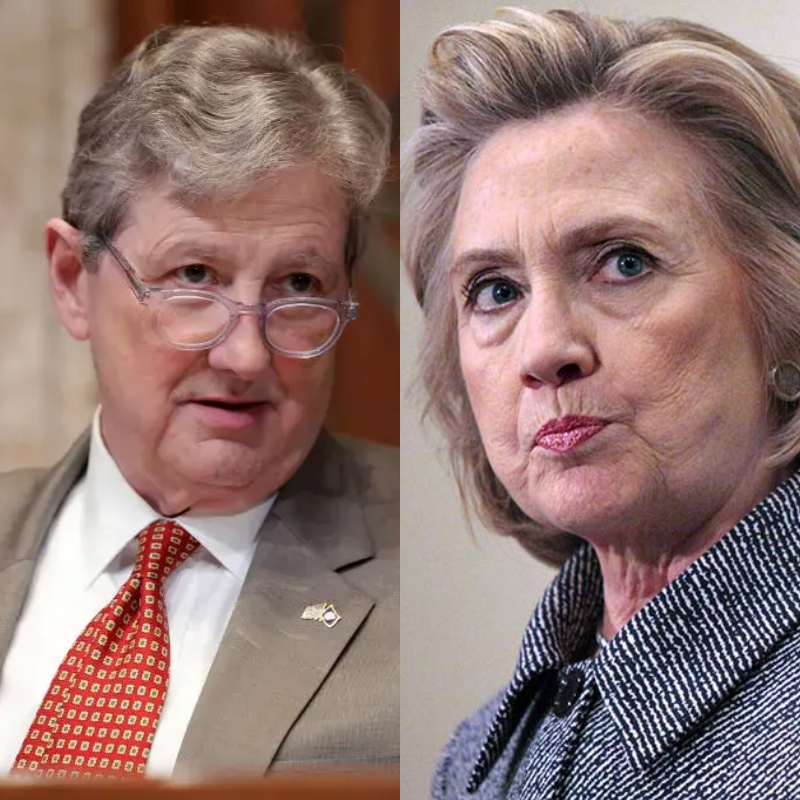
In a Senate hearing that will be dissected for decades, former Secretary of State Hillary Clinton faced the most devastating political cross-examination of her career at the hands of Senator John Kennedy. By the end of 73 relentless minutes, Clinton’s reputation, her alliances, and the very foundations of Washington’s elite lay in ruins. The fallout, already being felt in the corridors of power, promises to reshape American politics for a generation.
.
.
.
The morning began with Clinton arriving early, her confidence palpable. The Hart Senate Office Building’s Committee Room 216 was packed with reporters, protesters, and foreign observers sensing history in the making. Clinton’s plan was clear: humiliate Senator Kennedy, establish intellectual dominance, and breeze through the hearing. Her staff had prepared a dossier of Kennedy’s homespun quirks, aiming to expose him as a fraud.
But Kennedy was ready. Entering with a single, seemingly insignificant manila folder, he carried himself with the calm of a veteran prosecutor. Months of preparation—studying Clinton’s testimony, her psychological patterns, and defensive strategies—had led to this moment.
Clinton launched her attack with practiced contempt, mocking Kennedy’s “bayou lawyer” persona. The Democratic side of the room erupted in laughter. Kennedy absorbed the insult, showing no reaction except to jot a note and hold it up for the cameras: “Seven minutes to destroy you.”
His first question seemed almost naive:
“Did you have one email account or two?”
Clinton answered with condescension, dismissing the inquiry as beneath her. But Kennedy’s slow, deliberate follow-up—“So no private server?”—hit her like a splash of ice water. The simple question exposed a crack in Clinton’s armor. Her carefully prepared talking points began to unravel as Kennedy pressed on, methodically revealing inconsistencies in her story.
Kennedy’s questioning was relentless. He produced Clinton’s own memoir, quoting passages about her “convenient private system.” Each revelation was another blow, culminating in Kennedy’s infamous question:
“Ever hear of a program called BleachBit?”
Clinton’s composure faltered. Her denial sounded hollow. Kennedy, with theatrical precision, produced documents tying Clinton’s actions to the deletion of potentially incriminating emails. The gallery buzzed as reporters realized they were witnessing a historic unraveling.
Kennedy shifted gears, producing bank statements and wire transfers linking foreign donations to the Clinton Foundation.
“How much did Saudi Arabia donate to your foundation while you were Secretary of State?” Kennedy pressed.
When Clinton faltered, Kennedy supplied the answer:
“$25 million. Does that refresh your memory?”
The evidence was overwhelming. Saudi wire transfers, Chinese donations, Russian speaking fees, Uranium One payments—each detail meticulously laid out. Clinton’s staff began to panic, and her lawyer, David Kendall, whispered for her to keep answers short. But Kennedy was already three moves ahead.
As Kennedy revealed the extent of foreign money flowing into the Clinton Foundation, the tension in the room became palpable. A young staffer fainted. Security rushed in. The hearing teetered between drama and disaster. Yet Kennedy remained focused, his questions cutting through the chaos.
Then, in a shocking twist, Prince Khaled bin Sultan, a Saudi royal seated in the gallery, stood and confirmed his signature on a $25 million check. The room froze. Clinton’s face went ashen. Democratic senators began fleeing the chamber, realizing the gravity of the confessions unfolding before them.
The hearing took an even darker turn as video footage appeared on the main display—scenes from Haiti after the earthquake, juxtaposed with luxury hotels built with relief funds. A grieving Haitian mother stood in the gallery, accusing Clinton of broken promises and lost lives.
“You killed my daughter,” she cried. “She died waiting for the hospital you promised.”
Clinton tried to respond, but her microphone failed. The symbolism was unmistakable: her voice silenced as the evidence of misused aid played for all to see.
Kennedy turned to Benghazi, asking Clinton when she learned of the attack. A Marine officer in the gallery contradicted her timeline, revealing that help had been ready but never deployed. Clinton’s infamous defense—“What difference at this point does it make?”—echoed through the chamber, sealing her fate.
Kennedy produced emails showing Clinton had privately acknowledged the truth to her daughter, even as she told grieving families a different story. The gallery included a Gold Star widow who quietly demanded answers. Clinton’s defenses crumbled as Kennedy laid bare the human cost of political calculations.
With her lawyer abandoning her on live television, Clinton’s psychological defenses shattered. In a desperate bid for self-preservation, she began naming names—Obama, Biden, Pelosi, Schumer, McConnell—implicating half of Washington in a web of corruption. Her confessions spilled out in a torrent, each revelation more damning than the last.
Her lawyer’s final words—“I hereby withdraw as your counsel. Effective immediately.”—marked the end of her defense. Clinton stood alone, mascara streaked, surrounded by security, screaming about conspiracies and shadow governments.
As Clinton was escorted from the hearing room, her final words—“You don’t know what you’ve unleashed”—hung in the air. Reporters scrambled to file stories. Senators huddled, calculating damage. The gallery buzzed with disbelief.
Within hours, the FBI raided the Clinton Foundation and DNC headquarters. Indictments followed. The scope of the investigation ballooned:
183 officials under scrutiny
2.3 billion in suspicious transactions
Connections to seven foreign intelligence services
Major news networks purged archives, but internet sleuths preserved everything. The reckoning had begun.
Hillary Clinton, now inmate 77416, taught literacy classes in federal prison. The designer suits were gone, replaced by khaki. Her daughter Chelsea visited, and for the first time in decades, they spoke honestly.
“I became something I never meant to be,” Hillary confessed.
“You became what you thought you had to be,” Chelsea replied. “But maybe now you can just be my mom.”
Kennedy turned down book deals and speaking engagements, returning to Louisiana to fish and teach. His seminars on “the art of simple questions” became legendary.
“I didn’t destroy her,” Kennedy told his granddaughter. “I just asked questions. She destroyed herself with the answers.”
The Department of Justice launched Operation American Reckoning, the largest anti-corruption investigation in U.S. history. The fallout claimed careers, fortunes, and reputations. The political landscape was forever altered.
Clinton wrote a memoir from prison, dedicating it to Kennedy and the American people.
“I confused power with purpose, wealth with worth, control with strength. It took a senator from Louisiana to show me I wasn’t above anything.”
The hearing that began as a routine inquiry ended as a national reckoning. Kennedy’s precision, patience, and relentless pursuit of truth exposed the rot at the heart of American politics. Clinton’s collapse was both a tragedy and a warning—a lesson in the dangers of unchecked power and the redemptive power of truth.
As the sun set over Louisiana, Kennedy sat by the bayou, reflecting on the hardest truths.
“Sometimes we need to be completely broken before we can start to heal,” he said.
And somewhere in a federal prison, an elderly woman helped another inmate sound out words, finding purpose in service she’d never known in power.
The timer had stopped at 73 minutes, but the consequences would echo for years to com
They began arriving just after midnight — a steady line of motorcycles rolling quietly down our street, headlights glowing in the dark until nearly thirty riders stood outside my home. I froze in confusion and frustration. In my mind, bikers meant noise, disruption, and trouble, not something you’d expect in a peaceful suburban neighborhood. When they turned off their engines and simply stood there, looking toward my son’s bedroom window, every assumption I’d ever made about them came rushing forward, and my hand hovered over my phone ready to call for help.
Then one of them stepped forward, calm and concerned, holding his phone with a message he said I needed to hear. He explained that my sixteen-year-old son had been sharing worrying thoughts online — expressing deep sadness and frustration, hinting at ideas that could put him or others in emotional harm. As they showed me the posts, my heart sank. I had brushed off his quiet moods as normal teenage behavior, never realizing he was struggling inside. My denial faded instantly as I realized how much pain he had been trying to hide and how much I had missed.
Together, we walked to his room. The riders stayed gentle and respectful, speaking softly so he wouldn’t feel attacked or afraid. When the door opened, my son looked startled and overwhelmed — not dangerous, just a young person burdened by emotions he didn’t know how to manage. With care and patience, the bikers reassured him while I contacted professionals who could help immediately. Soon, trained experts arrived to talk with him and safely guide him toward the support he needed, ensuring his wellbeing and everyone’s peace of mind.
When the house grew quiet again, I sat in stunned gratitude. The people I once judged without knowing had shown up out of genuine concern and humanity. They saw what I missed and chose compassion over silence. That night changed me. It taught me never to judge someone by appearance, and to pay closer attention to the quiet signals my child gives. Most importantly, it reminded me that real strength is asking for help, offering help, and standing by someone when they need it most.