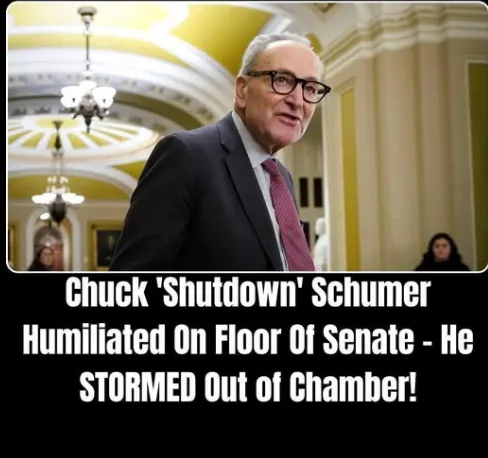
As the partial federal government shutdown stretched into its 39th day on Saturday, tensions in the U.S. Senate reached a boiling point. A brief but heated exchange between Senate Minority Leader Chuck Schumer and Sen. Bernie Moreno (R–Ohio) underscored the wider stalemate in Washington over how — and when — to restart federal operations.
The incident unfolded on the Senate floor after Schumer circulated a preliminary proposal aimed at ending the shutdown. At issue was his plan to extend Affordable Care Act (ACA) premium subsidies for one additional year, a move Democrats argue would protect millions of Americans from losing health coverage during the funding lapse.
 The Proposal and the Pushback
According to senators who witnessed the exchange, Schumer approached Moreno to outline the plan. The Democratic leader told his Republican colleague that the proposal was straightforward and would require only limited adjustments to the current funding structure for ACA subsidies.
“We can’t give you a counter in writing, but it’s very simple,” Schumer said, describing his suggestion as a short amendment involving “two sentences” that would prolong ACA benefits for one year.
The response caught Moreno off guard. The Ohio Republican pressed Schumer for more clarity, asking whether the proposal included income limits — a key issue for GOP negotiators, who argue that temporary expansions enacted during the COVID-19 pandemic had allowed even high-income households to qualify for subsidized insurance.
Moreno noted that, as written, the approach appeared to lack income thresholds. “It does still have no income caps, so people who make $1, $2, $3 million a year,” he said, before Schumer interjected.
Schumer insisted the one-year extension was intended as a temporary measure to stabilize health coverage while broader negotiations took place. “Once we pass the one-year fix so people right now aren’t in difficulty, we would sit and negotiate that,” he said, emphasizing that Senate Republicans had so far declined to enter formal talks.
A Heated Exit
The back-and-forth escalated when Moreno followed up with a blunt question: “So for one year, people making millions of dollars would still receive these COVID-era subsidies?”
Schumer bristled at the characterization and accused Republicans of prioritizing financial concerns for wealthy individuals over access to health care for lower-income families. At that point, witnesses say, the Democratic leader ended the conversation and left the chamber floor.
Moreno later spoke to reporters, expressing frustration at the abrupt departure. “I was going to ask him before he stormed out,” he said, adding that Schumer seemed unwilling to debate the finer details of the plan or address what Moreno called “substantial concerns” about program integrity.
The Ohio senator also said he wanted to raise additional questions about whether extending the subsidies — originally enhanced as part of pandemic relief measures — would maintain zero-premium plans and how much of the additional funding would effectively flow to insurance companies.
The Larger Standoff
The exchange came at a critical moment in the funding battle. The government has been shut down since October 1 following disagreements between Senate Democrats, Senate Republicans, and the White House over spending priorities.
Democrats have insisted that any funding package include a one-year extension of enhanced ACA premium subsidies, which were scheduled to wind down without new legislative action. These subsidies significantly reduced out-of-pocket costs for many households, but they have also drawn criticism from Republicans over cost, eligibility rules, and allegations of fraud.
Republicans, in contrast, argue that Democrats have tied shutdown negotiations to unrelated policy demands and have opposed efforts to pass a “clean” funding resolution. They say the enhanced subsidies were intended as temporary measures during the pandemic and should be revisited rather than extended automatically.
Democrats counter that pulling back the subsidies mid-shutdown would risk leaving millions of Americans without affordable coverage, creating a crisis for families who rely heavily on the ACA marketplace system.
The Political Calculus
Behind the policy debate is a growing sense among lawmakers that the political stakes are rising for both sides. Each party is under mounting pressure from constituents and advocacy groups to resolve the shutdown, which has halted or slowed numerous federal services and furloughed tens of thousands of employees.
President Donald Trump — whose administration is responsible for managing federal operations during the shutdown — has signaled that he will not support a deal that includes a broad extension of ACA subsidies without substantial reforms.
In an unexpected shift, Senate Democrats recently attempted to tie their subsidy proposal to the broader funding package, prompting sharp responses from Republican leadership, who accused Democrats of escalating the standoff.
Still, both sides acknowledge that ACA subsidies affect large portions of the population. Roughly 16 million Americans purchase insurance through the ACA marketplace, and many receive some level of financial assistance. The pandemic-era enhancements increased subsidy amounts and expanded eligibility, leading to record enrollment but also higher federal costs.
Negotiations Continue — Slowly
Despite the contentious moment on the Senate floor, staff for both parties confirmed that informal discussions continue behind closed doors. Senate Majority Leader John Thune (R–South Dakota) has stated publicly that Republicans are willing to negotiate once the government is reopened or a short-term funding extension is passed, but they have resisted linking the ACA subsidy issue directly to reopening the government.
Schumer, for his part, maintains that extending the subsidies is necessary to prevent disruptions for families enrolled in marketplace plans, many of whom face renewal deadlines in the coming months.
Some bipartisan policy analysts have suggested a possible compromise: a short-term extension of subsidies with temporary income caps and enhanced oversight measures to address fraud concerns. Whether that idea gains traction remains unclear.
Conclusion
Saturday’s exchange between Schumer and Moreno illustrates the deep divisions — not just over policy substance but over legislative strategy — that have prolonged the shutdown and stalled progress on a solution.
Until lawmakers reconcile their priorities, the standoff over subsidies and spending will likely continue to dominate congressional negotiations. And with the shutdown approaching six weeks, pressure is mounting for both parties to find common ground before the political and economic fallout grows even more severe.
The story that Washington’s power players prayed would never resurface has just detonated like a political earthquake.
After years of whispers, cover-ups, and finger-pointing, the Department of Justice has finally unsealed its long-awaited indictment against former FBI Director James Comey — and the revelations inside are every bit as explosive as insiders feared.
But as journalists and political operatives scrambled to digest the charges, two mysterious figures buried in the indictment stood out. They were not named directly but referred to in sterile legal code as
At first glance, those designations might have seemed meaningless — placeholders in a lengthy court filing. But within hours, new leaks and confirmations turned those two words into political dynamite.
Because “PERSON 1” has now been confirmed as Hillary Clinton, and “PERSON 3” as Comey’s longtime confidant and sometimes personal attorney, Daniel Richman.
And with that, the entire story of Comey’s post-2016 behavior — from his media leaks to his under-oath denials before Congress — is being rewritten before the public’s eyes.
When the indictment first dropped, Washington insiders were glued to one question: who exactly were these unnamed “persons” connected to the former FBI chief’s alleged crimes?
Now that their identities are known, the puzzle pieces fall into place.
According to ABC News investigative reporter Mike Levine, who broke the confirmation late Friday night, the DOJ’s first count against Comey centers on false statements made to the Senate Judiciary Committee in September 2020 — specifically, his sworn insistence that he never “authorized someone else at the FBI to be an anonymous source in news reports” regarding an investigation connected to Hillary Clinton.
The indictment tells a different story.