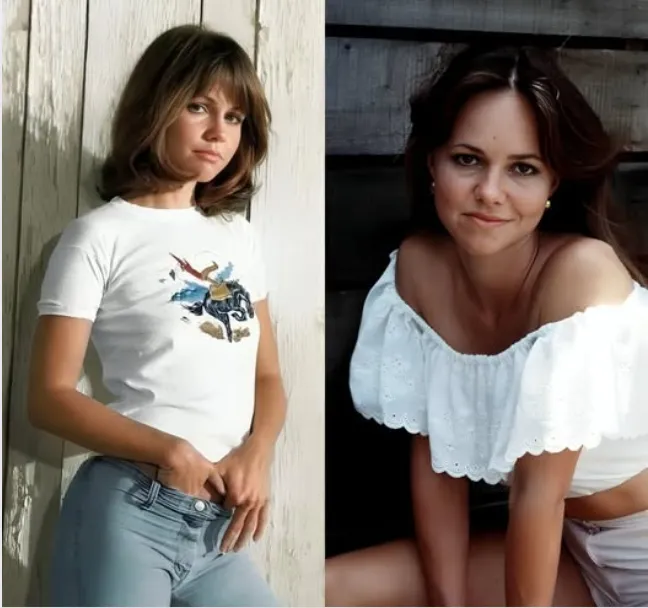
In the early 1970s, Sally Field was standing at a career crossroads that would determine whether she remained a charming TV darling or transformed into one of the most respected actresses of her generation. Up to that point, most of America knew her as the plucky teenager in
Gidget (1965–66) or the quirky, airborne novice in The Flying Nun (1967–70). She had become a cultural icon, instantly recognizable with her bright smile, bubbly personality, and undeniable charisma. Yet behind the glossy TV image, Field was restless. The fame she enjoyed felt limiting rather than liberating. As she would later admit, the industry saw her only as “the flying nun, not the actress.” What she wanted more than anything was to be taken seriously—a desire that would drive her to reinvent herself completely.
The dilemma she faced was one shared by many young performers who became too closely tied to early success. Typecasting in Hollywood is notoriously unforgiving, and for Field, the lighthearted sitcom roles that had made her famous now threatened to confine her permanently. Casting directors, producers, and even audiences struggled to see beyond her wholesome, comedic persona. She knew that if she did not take control of her career, she might never escape the box she had been placed in. That realization sparked a period of self-reflection and bold decision-making that would ultimately reshape her life.
As the 1970s began, Field sought out opportunities that were riskier, deeper, and far removed from the innocent charm of her earlier work. This was not an easy transition. Hollywood was skeptical, and her efforts to break free from her TV image were often dismissed. Yet she persisted, driven by an inner belief that her talent had yet to be fully recognized. It was this persistence that led her to the role that would change everything:
Sybil (1976).
In Sybil, a groundbreaking television film based on a true story, Field played a young woman grappling with dissociative identity disorder, embodying more than a dozen distinct personalities. The role demanded not just technical precision but also extraordinary emotional vulnerability. For audiences accustomed to seeing her in lightweight comedies, the transformation was nothing short of shocking. Field delivered a performance that was raw, haunting, and unforgettable. Critics were stunned, audiences were moved, and for the first time, Hollywood was forced to acknowledge her dramatic power. She won an Emmy for the role, but more importantly, she won the respect she had been fighting for.
That performance marked the moment when everything changed. It was as though Field had finally broken through a wall that had long stood in her way. Suddenly, she was not just the girl-next-door sitcom star—she was an actress with depth, range, and the courage to take on the darkest corners of human experience. From there, the trajectory of her career shifted dramatically.
By the late 1970s and into the 1980s, Field’s transformation was complete. She began taking on roles that explored resilience, struggle, and humanity with authenticity and grace. In Norma Rae
(1979), she portrayed a Southern textile worker who becomes a union organizer, a role that earned her the Academy Award for Best Actress. Her portrayal of Norma Rae Webster was grounded, fiery, and deeply human, reflecting not only her skill but also her commitment to portraying women with strength and complexity. Just a few years later, she won a second Oscar for
Places in the Heart (1984), further solidifying her place among Hollywood’s most respected leading actresses.
Yet the story of her reinvention is not only about awards and accolades. It is also about the courage it took for a young woman to reject the safety of typecasting in favor of the unknown. In the 1970s, Field could have easily coasted on the goodwill of her sitcom fame, taking on similar roles and remaining in the comfortable lane that Hollywood had created for her. Instead, she chose the harder path, risking failure and rejection in pursuit of artistic truth. That decision required resilience, persistence, and a belief in herself that refused to be shaken by the doubts of others.
What makes her transformation even more compelling is the way she managed to maintain her warmth and relatability even as she took on increasingly serious roles. Unlike some actors who shed their early personas completely, Field found a way to bridge the gap between her wholesome beginnings and her dramatic depth. This balance gave her a unique place in American culture: she was both the familiar, down-to-earth presence audiences had grown up with and the commanding performer capable of bringing gravitas to the screen.
Looking back, it is clear that the reinvention Field achieved in the 1970s was not just a career move but a personal rebellion against the limitations imposed on her. She refused to let the industry define her, instead insisting on defining herself. That refusal is what paved the way for her longevity. Decades later, whether in
Steel Magnolias (1989), Forrest Gump (1994), or Lincoln (2012), she continued to deliver performances that were layered, authentic, and deeply moving.
Sally Field’s story is a testament to the power of persistence and reinvention. She began as America’s sunny sweetheart, beloved but underestimated, and through sheer determination, transformed herself into one of the most respected actresses of her time. The quiet rebellion she staged in the 1970s was the foundation for everything that came after—the Emmy, the Oscars, the enduring admiration of critics and audiences alike. By daring to become more than what the world expected of her, Sally Field not only redefined her career but also set an example for every performer who has ever struggled against the weight of typecasting.
It all began with that moment in the early ’70s when she decided she would no longer be content with being just the Flying Nun. She wanted to be an actress, fully and completely—and she proved it.
You might know her as the fearless, no-nonsense Sgt. Callahan from Police Academy and the chilling villain in Rob Zombie’s horror classics.
But Leslie Easterbrook’s journey is more than just legendary roles — it’s a masterclass in reinvention.
From small-town Nebraska to Hollywood fame, she shattered stereotypes and redefined what it means to be a tough woman on screen. But where is she now?
Leslie Easterbrook’s career is a testament to versatility, resilience, and an undeniable screen presence
While many recognize her as the formidable and hilarious Sgt. Debbie Callahan from
Born in Nebraska and adopted at just nine months old, Leslie’s upbringing in the Midwest shaped her grounded and pragmatic outlook on life. Her adoptive father, a music professor, and her adoptive mother, an English teacher, nurtured a love for both education and music. As the only child of singing parents, Leslie was always surrounded by the sound of music.
”It was natural for us to share our love of music with Leslie. We thought she had a sweet voice, and of course, we encouraged her to join vocal groups, but it wasn’t until she went to college that we discovered what a remarkable voice she really has,” her mother told Omaha World-Herald in 1977.
Leslie Easterbrook aspired to be an opera singer, but after graduating from Kearney High School and later attending Stephens College, Easterbrook seemed destined for a conventional life. But Hollywood had other plans.
Her big break came in 1980 when she landed the role of Rhonda Lee on Laverne & Shirley, the long-running ABC hit. As the series transitioned from Milwaukee to California, her character — a glamorous, sharp-witted neighbor — quickly became a standout in the later seasons.
”It was really an amazing experience that I finally got to be a part of the show, playing the Rhonda character. Just as I got the part, there was a SAG strike. Then when the strike was over, I got a call telling me I needed to audition again for the part I thought I had already gotten. It wasn’t until six auditions later that I finally got the part and was able to start working,” Leslie once shared.
But it was her portrayal of Sgt. Callahan in Police Academy that truly made her a star. Initially hesitant about playing such a dominant, sexually confident character, Easterbrook embraced the challenge. Her commanding presence, sharp comedic timing, and fearless energy turned Callahan into a cult favorite – it’s impossible to not remember the tough and no-nonsense instructor at the police academy.
”The funny thing is, that’s not me at all. I’d never played tough. I’d played all kinds of things, but I’d never played someone who’s intimidating or someone that was aggressive sexually. I was of a size that I never played the girl who got the guy. I wondered how I could do it. But I did. I went for the audition and I scared the producer and the director and then they backed up in their chairs and I went ‘Oh no, now I really blew it. I scared them.’ So I left the audition upset. I didn’t get to read the script until I got the part. I thought it was outrageous and so funny,” Leslie once said.
Throughout her years as an actress in Hollywood, Leslie was always dedicated to staying in shape — despite her love of good food. She was an avid athlete, playing on a volleyball team, excelling as an equestrian, and maintaining a strong passion for running. Twice a week, she ran about 10 miles per session, keeping herself in peak condition. In addition, she took dance classes and worked out regularly at the gym.
To prepare for her roles in Police Academy, she took her training even further, undergoing intensive karate and martial arts classes to bring strength and authenticity to Sgt. Callahan’s fearless persona. And did you know that Leslie Easterbrook’s character name ”Callahan” is said to be a play on Clint Eastwood’s famous Dirty Harry character?
Yet, Police Academy was just one chapter in her extensive career. With over 300 television appearances, she left her mark on shows like Murder, She Wrote, Baywatch, Matlock, and The Dukes of Hazzard.
She even ventured into films like Private Resort before shifting into horror in the 2000s and doing movies like The Devil’s Rejects.
”The horror genre intrigues me in many ways, but I am always amazed by the stressful nature of the entertainment. Much of it is grizzly and grinding, but when I meet the fans, they are the most cheerful and delightful people in the world. I meet their children, and their parents. They are good, law-abiding, regular, delightful people. My favorite theory is that they have found a venue to exorcise their demons — and are probably the healthiest folks around,” Leslie said.
When people talk about Private Resort (1985), they usually mention one thing: Johnny Depp. The film is mostly known for being Depp’s first lead role in a theatrical feature, alongside Rob Morrow. A classic ’80s teen sex comedy, Private Resort leans heavily on bikinis, bare skin, and over-the-top hijinks to sell itself.
But for those who’ve actually seen the movie, another name often comes up—Leslie Easterbrook.
Easterbrook plays Bobbie Sue, a seductive and sharp-witted woman who gets tangled in the wild weekend antics of Jack (Depp) and Ben (Morrow) at a luxurious beachside resort. Her character is at the heart of one of the film’s major subplots, using her charm and cunning to create a whirlwind of chaos and comedy.
What makes Easterbrook’s performance stand out is her ability to blend sultry allure with perfect comedic timing.
She brings a mischievous energy to Bobbie Sue, elevating the film’s humor and proving once again that she had a knack for playing strong, playful, and unpredictable women. While Private Resort never became a cinematic classic—or a highlight in Johnny Depp’s career—it delivers exactly what audiences expected from ’80s comedies: troublemaking, absurd situations, and just the right amount of mischief.
Behind the scenes, Easterbrook had her own boundaries. She agreed to only expose her backside in the film, a clause written into her contract. However, producers allegedly convinced her to wear a sheer negligee that, under bright lights, left little to the imagination.
As for Depp and Morrow? They were so embarrassed by Private Resort that they reportedly made a pact to track down and destroy every existing copy. Safe to say, they failed—because decades later, the film lives on, with Leslie Easterbrook’s unforgettable performance as one of its most talked-about highlights.
Beyond acting, Easterbrook’s talents extended to music. She had a big strong voice and she sang the The Star Spangled Banner at several games for the Los Angeles Dodgers at the California Angels in the early 1980s.
Perhaps her proudest moment came when she sang the national anthem at Super Bowl XVII in 1983. But her journey to performing the song at the Rose Bowl stadium in Pasadena, was filled with mishaps and close calls.
It all started with her singing at Angel’s games for free tickets, where her talent caught the attention of the Los Angeles Rams’ Head of Entertainment. Word spread, and soon she was being considered for the Super Bowl gig.
But things never seemed to go smoothly for her. After a fender bender made her miss the game where NFL commissioner Pete Rozelle planned to hear her sing, she sent him a tape instead. Finally, she landed the job, but the chaos didn’t end there.
Her limo driver got lost, security wouldn’t let her in, and she had to run across the Rose Bowl parking lot in high heels while carrying her dress. Once she made it, she barely caught her breath before performing.
As she prepared to sing, she joked with the honor guard, and from there, everything went perfectly — though some players even patted her on the back as if she were one of them. It was a wild, unforgettable experience full of missed moments, but it all came together in the end.
Off-screen, Leslie has been a vocal advocate for firearm safety and education, creating instructional videos for beginners.
In the early 1990s, she decided to learn how to shoot a shotgun, a choice driven by an accident during a Police Academy video shoot.
She had been asked to fire a starting pistol to signal the beginning of a foot race. To get the best shot, the camera operator instructed her to hold the pistol close to her face. Unaware that she needed ear protection, she fired the gun, and the sharp blast shattered her eardrum.
The experience made her realize that if she was ever going to handle a firearm in a movie again, she needed to fully understand how to use them. She reached out to her friend Lee Purcell, an experienced shooter, who helped her get started.
Despite challenges with her vision, she committed herself to mastering shotgun shooting. The training was difficult, time-consuming, and expensive, but she persisted. Two years later, she won first place in D Class at the California State Trap Shoot. Though it was the lowest class, the victory was significant, as she had managed to outperform 400 men who had been shooting their entire lives.
Her dedication to philanthropy, particularly supporting children’s charities and law enforcement organizations, further highlighted her commitment to causes beyond Hollywood.
Her marriage to screenwriter Dan Wilcox was a defining part of her life, lasting until his passing in 2024. Through it all, Leslie Easterbrook remained a force to be reckoned with—never content with being typecast, always pushing the boundaries of what was expected of her.
The veterans film actress’ legacy isn’t just one of Hollywood success; it’s a story of reinvention, fearlessness, and leaving an indelible mark on every medium she touched. She remains good friends with her former Police Academy co-star Scott Thomson and shared a close bond with the late Marion Ramsey. Easterbrook has often said that the cast of the original film felt like one big family.
Leslie Easterbrook, now 75, has proved that true icons can never be put in a box. As of 2025, she has never retired from acting, though she has had few prominent roles in recent years. Her latest credit is from 2022.
And does she still look just as stunning today? Absolutely!
In 1954, Marilyn Monroe was at the height of her fame, one of the most photographed women in the world, a Hollywood icon draped in sequins, curls, and allure. Yet on the rugged set of River of No Return, filmed in the untamed landscapes of the Canadian wilderness, Monroe became something different—an actress who endured physical pain, dangerous conditions, and an unforgiving production to prove she was more than just a glamorous screen siren.
The film, directed by Otto Preminger and co-starring Robert Mitchum, tells the story of Kay Weston, a saloon singer swept up in a perilous journey downriver through hostile frontier territory. Unlike Monroe’s earlier roles, which leaned heavily into her persona as a charming and effervescent sex symbol, this part demanded endurance, grit, and vulnerability. For Monroe, the role meant wading into icy waters, navigating treacherous rapids, and braving weeks of difficult location shooting far from the controlled environment of Hollywood sound stages.
The production itself was infamous for its hardships. Preminger, known for his uncompromising style, pushed his cast and crew to extremes to capture the raw authenticity of the wilderness. Monroe, unaccustomed to such grueling conditions, faced both physical and emotional challenges. During one rafting sequence, she slipped on a wet rock and suffered a serious ankle injury. Production was halted, newspapers speculated about her future on the film, and whispers circulated that she might be too fragile for the demands of such a project. What was often overlooked, however, was Monroe’s quiet perseverance. She returned to the set, bandaged and limping, and continued to perform despite the pain. This resilience earned her the respect of Robert Mitchum, a seasoned actor not easily impressed. Mitchum later praised Monroe for her vulnerability, honesty, and determination, qualities that were too often overshadowed by her image as Hollywood’s “blonde bombshell.”
What makes River of No Return so significant in Monroe’s career is the timing. The mid-1950s marked a turning point for her, both professionally and personally. Just after completing this film, Monroe began to challenge the studio system that had long typecast her. Dissatisfied with being pigeonholed into decorative roles, she sought greater creative control over her career. In 1955, she founded Marilyn Monroe Productions, a bold and unprecedented move for a female star of her time. In retrospect, her work in River of No Return can be seen as a prelude to this evolution—a project that forced her to push beyond glamour and tap into her deeper potential as an actress.
Although critics at the time were divided—some dismissing the film as a routine western adventure while others noted Monroe’s surprising screen presence—the box office told a different story. Audiences flocked to theaters, and the film became a commercial success. Decades later, Monroe’s performance is reappraised with greater appreciation. Modern critics recognize that within the confines of a genre not typically known for complex female characters, Monroe infused Kay Weston with warmth, humor, and resilience. Her portrayal hints at the emotional depth she would later bring to films like Bus Stop (1956) and The Misfits (1961).
Behind the sweeping shots of raging rivers and wide frontier vistas lies a quieter, more personal story of Monroe’s endurance. She was, at that moment, balancing the pressures of fame, the demands of studio contracts, and her own growing desire for independence. On-screen, she was the saloon singer who found unexpected strength in the wilderness. Off-screen, she was a woman beginning to assert control over her career and identity.
River of No Return may not rank among Monroe’s most iconic films like Gentlemen Prefer Blondes or Some Like It Hot, yet it remains a fascinating chapter in her story. It reveals her willingness to take risks, to endure discomfort, and to prove herself as more than a pretty face in glamorous gowns. Her ankle injury and perseverance became symbolic of her larger struggle in Hollywood: despite setbacks, doubts, and constant scrutiny, she kept moving forward.
Today, the film stands as a testament to Monroe’s resilience and complexity. While it may not showcase the comedic brilliance or dramatic intensity she displayed in later roles, it offers a glimpse of an actress in transition—caught between the image imposed on her by the industry and the artist she aspired to be. In braving the icy rivers and rugged terrain of the Canadian wilderness, Monroe was doing more than making a movie; she was carving out her identity as a serious performer, one determined to endure, evolve, and leave behind more than just an image of beauty.