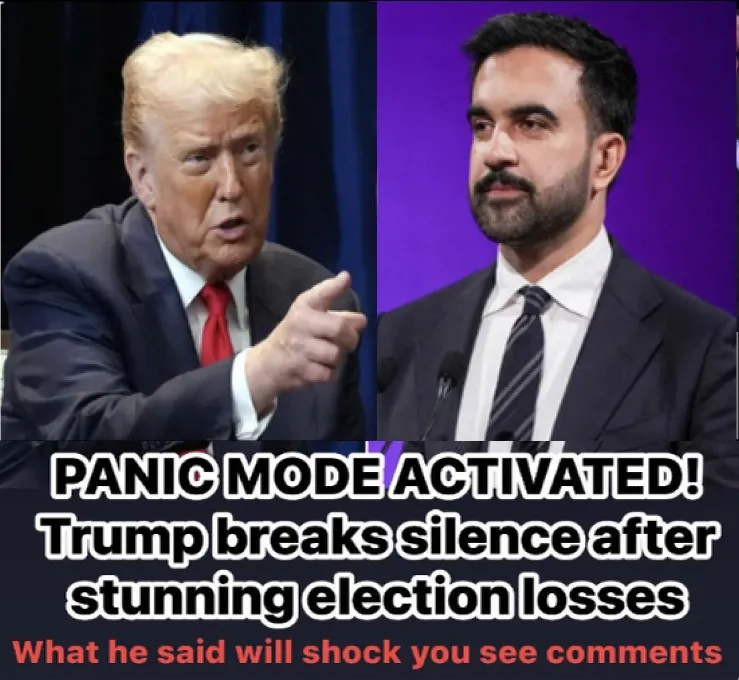
President Trump pointed to “pollsters” who say the government shutdown — combined with the fact that his name wasn’t on Tuesday’s ballot — were key reasons behind the Republican losses on Election Day.
“‘TRUMP WASN’T ON THE BALLOT, AND SHUTDOWN, WERE THE TWO REASONS THAT REPUBLICANS LOST ELECTIONS TONIGHT, according to Pollsters,” Trump posted on Truth Social on Tuesday night.
Republicans lost major races on Tuesday, though the vast majority of them were in deep blue states and districts.
In New York City, socialist candidate Zohran Mamdani defeated a rare bipartisan coalition that had rallied behind former Governor Andrew Cuomo (D) to win the mayor’s race.
Out west, California voters approved Proposition 50, effectively dismantling the state’s two-decade-old independent redistricting system. The measure clears the way for a new congressional map that could hand Democrats as many as five additional House seats in the 2026 midterm elections.
“It was not expected to be a victory. I don’t think it was good for Republicans. I’m not sure it was good for anybody, but we had an interesting evening, and we learned a lot,” Trump said at a Wednesday morning breakfast with GOP senators.
In New Jersey, a race that many expected to be close turned into a decisive win for Democrat Mikie Sherrill, who defeated Republican Jack Ciattarelli by a double-digit margin — 56.2% to 43.2% — with 95% of ballots counted as of Wednesday morning.
In Virginia, Democrat Abigail Spanberger also scored a commanding victory, defeating Republican Winsome Earle-Sears by more than 15 points, 57.5% to 42.3%, with 96% of votes tallied.
For comparison, former President Donald Trump lost both states in the previous year’s election — by 5.7 points in Virginia and 5.9 points in New Jersey,
House Republicans are exploring legal and constitutional strategies to block Mamdani from being sworn into office, citing the Constitution’s post–Civil War “insurrection clause.”
The effort, first reported by the New York Post, is being led in part by the New York Young Republican Club, which argues that Mamdani’s past statements calling to “resist ICE” and his ties to left-wing organizations could qualify as “giving aid or comfort to the enemies” of the United States — language drawn directly from Section 3 of the 14th Amendment.
That provision, enacted in 1868, bars from public office any person who has “engaged in insurrection or rebellion” against the United States, or who has provided “aid or comfort” to its enemies.
The clause was originally intended to prevent former Confederate officials from holding office but has recently re-emerged in political debates over ballot eligibility.
“There is a real and legitimate push to see the insurrectionist Zohran Mamdani either a) removed from the ballot or b) removed from office if he is to win on Tuesday,” said Stefano Forte, president of the New York Young Republican Club.
Several House Republicans are said to be reviewing whether the clause could be enforced through new legislation or congressional action following the election.
The idea mirrors the legal arguments used in Colorado last year to try to disqualify Trump from the state’s ballot — a move the Supreme Court ultimately overturned, ruling that Congress, not individual states, has the constitutional authority to enforce Section 3.
The Court’s decision has emboldened some GOP lawmakers who believe the ruling effectively places responsibility for such enforcement in the hands of Congress, where Republicans currently hold a narrow 219–213 majority in the House.
According to two congressional aides, Republican leaders may consider holding a post-election vote to declare Mamdani ineligible for office under the clause. Such a measure would face significant procedural and legal hurdles, including a likely filibuster in the Democrat-controlled Senate and near-certain court challenges.
Six women who say they were trafficked by Jeffrey Epstein or his longtime associate Ghislaine Maxwell made a public appeal on Tuesday in Washington, D.C., demanding the federal government release more investigative files. They also urged former President Donald Trump to publicly rule out a pardon for Maxwell. The women appeared alongside family members of Virginia Giuffre, a prominent Epstein accuser who died by suicide in April, and criticized what they called a long-standing failure to deliver justice.
Jess Michaels, who alleges Epstein raped her in 1991, described him as a “master manipulator” and said his behavior followed a calculated strategy that left young women and teenage girls defenseless. Michaels cited a “severe miscarriage of justice” and delays in accountability as her motivation for speaking out. Her remarks echoed the sentiments of other survivors who say they were also groomed and abused.
Wendy Avis and Jena-Lisa Jones, both of whom say they were 14 when Epstein abused them, condemned the silence of adults who may have witnessed the abuse. Jones stated that many people around Epstein “very clearly knew what was going on” but have refused to speak up. Avis, speaking publicly for the first time, stressed that victims like her still haven’t received justice, calling for broader recognition of the everyday people affected.
All six women, including Marijke Chartouni, Lisa Phillips, and Liz Stein, expressed deep frustration with the Justice Department. Stein accused officials of failing to protect or inform survivors and backed bipartisan efforts in Congress to force transparency. Their statements came just before the Republican-led House Oversight Committee released over 33,000 pages of Epstein-related documents.
Reps. Ro Khanna and Thomas Massie are leading a legislative push to investigate alleged mishandling of the federal probes into Epstein and Maxwell. Maxwell, currently serving a 20-year prison sentence, continues to deny wrongdoing. Phillips warned that if the system continues to fail them, survivors are prepared to take justice into their own hands: “We’ll compile our own list.”
In the high-stakes world of politics, timing can determine success or failure. This truth was starkly illustrated by California Governor Gavin Newsom’s recent ultimatum directed at former President Donald Trump regarding the contentious issue of redistricting. Newsom, aiming to curb the aggressive redistricting efforts led by Texas Republicans—which threatened to redraw district boundaries to favor their party—issued a public warning. He declared that if Trump did not “stand down” within 24 hours and cease supporting the Texas redistricting plan, California would retaliate by initiating its own redistricting process to reshape California’s congressional map in a way that would favor Democrats.
However, this bold move quickly backfired and exposed several strategic weaknesses. The 24-hour deadline gave Texas Republicans ample time to rally their forces and solidify their position, rather than forcing a retreat. Critics were quick to point out that California’s redistricting process is overseen by an independent commission, making any sudden changes by the governor a slow and uncertain endeavor. This is in stark contrast to Texas, where Republicans control the state legislature and can swiftly pass partisan redistricting maps without such checks and balances.
Texas Governor Greg Abbott seized the moment to highlight the disparity between the two states’ political power dynamics. He noted that Texas had the ability to eliminate twice as many Democratic districts as California could create Republican ones, thus underscoring the practical limitations of Newsom’s threat and the broader imbalance in political influence.
The repercussions of Newsom’s ultimatum were significant. Rather than deterring Texas Republicans, the move emboldened them and strengthened their resolve. It also damaged the credibility of Democrats, particularly on the sensitive issue of voting rights, as many saw the threat as a politically motivated overreach rather than a principled defense of democracy. Furthermore, Texas Attorney General Ken Paxton escalated the conflict by pursuing legal actions against Democratic lawmakers who opposed the redistricting plans, deepening the partisan divide and sparking further controversy.
Conservative media outlets capitalized on the situation, portraying Newsom’s ultimatum as evidence of Democratic arrogance and overreach. This framing intensified political polarization and left Newsom facing the consequences of a gambit that, instead of showcasing strength, revealed vulnerabilities within the Democratic leadership.
In conclusion, Gavin Newsom’s ultimatum to Donald Trump over redistricting serves as a cautionary tale about the complexities of political strategy. While well-intentioned in its goal to protect fair representation, the timing, execution, and political context led to a strategic disaster that ultimately strengthened opponents, weakened Democratic credibility, and fueled ongoing legal and political battles.